
News
2026 “Jugend forscht” Berlin-Buch regional winners
06.03.2026 / From pond water probes to pesticide impact and chili-infused soil: 85 young researchers presented 43 projects at the “Jugend forscht” regional science competition at Campus Berlin-Buch. Under the theme “Maximum Perspective,” students tackled real-world challenges with curiosity and creativity.
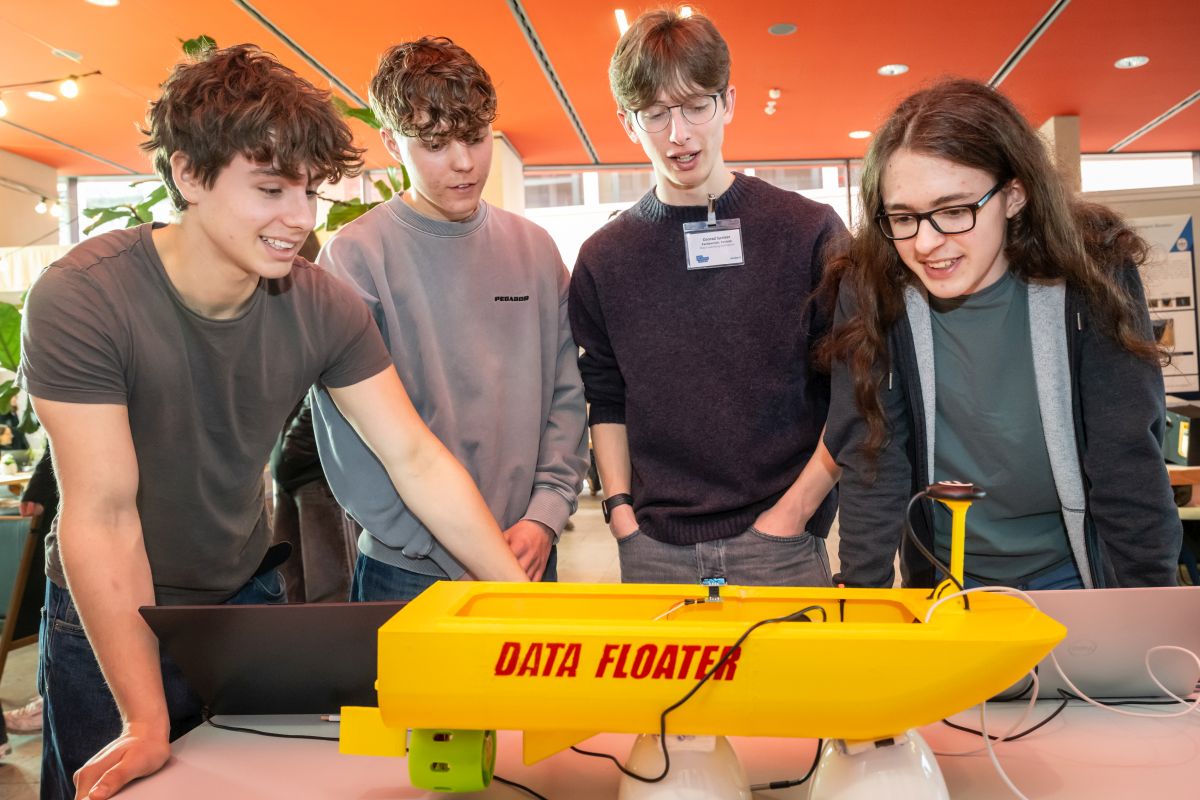
Carlo used to walk by a pond every day on his way to school. He always wondered how clean the water was; Cosima wanted to know whether pesticides reduce populations of a bacteria important for fixing nitrogen in soil; and Fin found himself asking whether capsaicin – the primary compound in chili that makes the tongue tingle and burn – might impact vegetable growth.
These were just a tiny sampling of students’ curiosity driven questions that turned into projects presented during the “Jugend forscht” regional science competition, which took place in the Max Delbrück Center Communications building at Campus Berlin-Buch on February 25, 2026. To encourage future oriented thinking, this year’s theme was “Maximale Perspektive,” or “Maximum Perspective.” Students could submit projects in mathematics, computer science, natural sciences, and technology that represented innovative solutions to societal problems and featured creative and critical thinking.
Fun and curiosity are essential
Ulrich Scheller, Head of Campus Berlin-Buch, kicked-off the event with an opening speech and encouraged the students to “have fun and to always remain curious.” During the course of the afternoon, a total of 85 students aged eight to 20 years-old presented 43 science projects to jury members and the public.
Carlo, a sixth grader, built a floating platform with a hole through which he could test the pond water for acidity and other pollutants using various probes. Cosima found that the pesticide glyphosate – a common weed killer – can negatively impact a species of bacteria important for fixing nitrogen in the soil. And Fin found that capsaicin, when added to soil, inhibits root growth of garden cress.
Many of the students’ project ideas were inspired by personal experiences. A team of students from the Käthe Kollwitz Gymnasium, for example, built a camera drone attachment that could take more detailed images of people than many existing commercially available cameras. The project was inspired by a student’s experience of their grandparents’ town being flooded. Emergency crews were unable to easily find people in need of evacuation. And several students expressed dismay over mounting plastic waste in the oceans, which sparked their interest in designing biodegradable plastics.
Research begins with questions
Before the awards ceremony on Friday, February 27, participants had the chance to take guided tours of laboratories at the Max Delbrück Center, the Leibniz Research Institute for Molecular Pharmacology (FMP) and FyoniBio, a start-up located on the campus. Students could also conduct hands on experiments as part of a course offered by the Gläsernes Labor.
In the afternoon, the jury awarded prizes – which included money, subscriptions to science publications and visits to exhibitions – in two separate age groups “Jugend forscht Junior” and “Jugend forscht” in four main categories: Biology, Chemistry, Physics, Technology. It also awarded a singular prize in the category Interdisciplinary. First place winners will advance to the state competition held at the Technical University of Berlin.
In addition, several special prizes were handed out in all science categories and special categories such as environmental technology and engagement. These prizes were sponsored by the Max Delbrück Center, FMP, Gläsernes Labor & Campus Berlin-Buch and others.
“We are thrilled to be able to spark young people’s enthusiasm for science,” Kirsten Bodensiek, Head of the Administrative Directorate at the Max Delbrück Center told students during the ceremony. “Science begins not with answers, but with smart questions. Through your projects, you are making a contribution to the science of tomorrow.”
“It’s really great to see you here every year,” added Dr. Henning Otto, Scientific Administrator at the FMP. “You are all simply amazing! If you are considering a career in science, choose a place like this – a nice campus with lots of curious people.”
The winners
Biology
Prizes courtesy of Helmholtz Gemeinschaft, Deutscher Forschungszentren e.V.
3rd Place: Marie Thürling, Frieda Kliche, Charlotte Lange
Hans-und-Hilde-Coppi-Gymnasium
“How does the vitamin content of fruit change under different types of processing?”
3rd Place co-winner: Marek Ebert
Käthe-Kollwitz-Gymnasium
“Hydroponics from the very start.”
2nd Place: Klas Koesling
Rosa-Luxemburg-Gymnasium
“Use of coffee waste to produce high-quality animal feed ingredients.”
Winner: Cosima Höer, Moritz Pasternak
Freie Universität Berlin, Primo-Levi-Gymnasium
“Nitrogen-fixing soil bacteria – do pesticides and fertilizers have an impact?
Biology Jugend forscht Junior
3rd place: Carlo Kühn
Primo-Levi-Gymnasium
“Study of a pond”
There was no second-place winner
Winner: Leif Neuberger, Oskar Kubitschko, Julian Dietrich
Lessing-Gymnasium
“Stop mold, natural paints put to the test.”
Chemistry
Prizes courtesy of Fonds der Chemischen Industries im Verband der Chemischen Industrie e.V.
3rd place: Cedric Neuberger
Lessing-Gymnasium
“Soda lime – our climate savior?”
2nd place: Pepe Fynn Jost, Sarah Herrmann, Anna Skrabania
Primo-Levi-Gymnasium
“Building your own gas chromatograph”
Winner: Giulia-Matilda Oettel
Lessing-Gymnasium
“Self-Healignin – Development of a fiber-reinforced thermoplastic based on lignin”
Chemistry Jugend forscht Junior
Winner: Lina Ebert
Heinrich-Roller-Grundschule
“The curry stain must go!”
Physics
Prizes courtesy of Max Planck-Gesellschaft zur Förderund der Wissenschaften e.V.
3rd place: Vico Grollmus, Maria Anufrieva
Primo-Levi-Gymnasium
“3D-printed interferometer for student experiments.”
2nd place: Magnus Vogel
Robert-Havemann-Gymnasium
“Setup, calibration, and use of a 3M radio telescope.”
Winner: Kari Linnea Geisinger
Herder-Gymnasium
“The tea bag oscillator.”
Physics Jugend forscht Junior
Winner: Lino Phielipeit, Simon Wiese
Primo-Levi-Gymnasium
“Table tennis reloaded.”
Technology
Prizes courtesy of VDI e.V
3rd place: Rasmus Wilke
Käthe-Kollwitz-Gymnasium Berlin
“Autonomous boat for collecting and measuring data from water”
2nd place: Tony Nguyen
Käthe-Kollwitz-Gymnasium Berlin
“FocusPilot Learning calm with self-control”
Winner: Conrad Speiser
Rosa-Luxemburg-Gymnasium
“Firebug bionic infrared sensor for intelligent fire detection”
Winner Interdisciplinary: Siddharta Kollar, Iulia Dinu
Käthe-Kollwitz-Gymnasium Berlin
“Sentr: an automated solution for product logistics in supermarkets”
Technology Jugend forscht Junior
2nd place: Ryan Bartsch, Rodja Cichos
Primo-Levi-Gymnasium
“Micro-mouse”
There was no first-place winner.
Source: Max Delbrück Center2026 “Jugend forscht” Berlin-Buch regional winners

