
News
“The coolest part is vortexing”
21.08.2026 / One week, two topics, and plenty of new experiences: 25 young people take a deep dive into research on rare diseases and immunology at the Life Science Learning Lab “Gläsernes Labor,” including by analyzing their own genes.
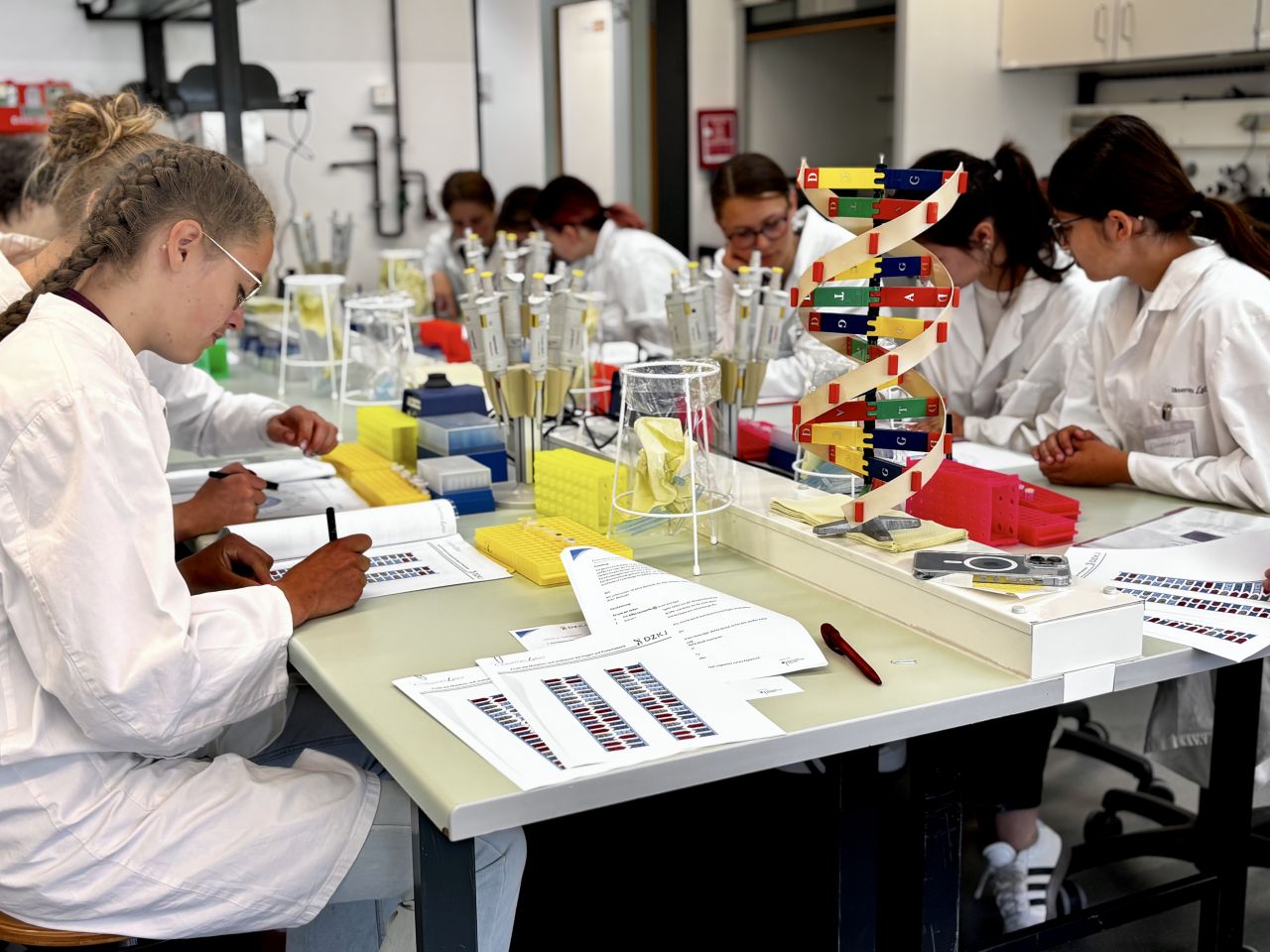
Stella stares intently at the reaction tube in her hand. The tall girl is standing at a lab bench in the Gläsernes Labor on the Buch campus. The “Rare Diseases” group is conducting its final experiment during the Gläsernes Labor project week. The 25 teenagers, aged 13 to 19 — most from Berlin and some from the surrounding Brandenburg area — want to find out how much a sample can be diluted while still yielding results from the polymerase chain reaction (PCR). The group’s concentration is palpable: For the experiment to work, they have to pipette precisely and carefully. But it’s also fun. “The vortexing was definitely the coolest part of this week,” says Stella, laughing as she tosses her long blonde ponytail over her shoulder. To “vortex,” samples are placed on an electric shaker or vortex mixer, which causes the container to vibrate rapidly. This ensures that the components of the liquid mix thoroughly.
This project week is special. Unlike the Gläsernes Labor’s usual course program, it does not take place as part of the school curriculum during the year, but rather during summer vacation. “Young people sign up out of their own interest, which creates a completely different dynamic,” says Ulrike Mittmann, a biotechnologist. The scientist oversees the molecular biology program at the Gläsernes Labor. The subjects of the project week — rare diseases and immunology — are also key focus areas for the German Center for Child and Adolescent Health (DZKJ), which launched and designed the project week in collaboration with the Gläsernes Labor and the Max Delbrück Center in 2025. “It’s important to us that young people get to know what everyday research is like and understand what concrete steps are being taken to advance research to improve children’s health,” says Dr. Nancy Freitag, scientific project manager at the DZKJ.
A visit to a research lab
The final day of project week is heading into the home stretch with plenty of energy and a good dose of scientific input. Over the past few days, Stella and the other teens have learned and applied the fundamentals of current research. Now they’re discovering how this knowledge is put to use in everyday research.
Dr. Kerstin Fentker, a postdoctoral researcher in the Proteomics Research Group at the Max Delbrück Center, presented her DZKJ-funded work on cystic fibrosis, a disease that, like many rare diseases, begins in childhood or adolescence. About three to five out of every 10,000 children develop the disease. “The cause is a genetic defect that impairs an ion channel on cell surfaces. This throws the salt-water balance out of equilibrium: too little water reaches the mucosal surface, and thick mucus forms in the lungs,” explains the researcher. Bacteria multiply in this mucus, leading to repeated infections and inflammation.
Fentker has been investigating how two specific medications influence these processes. Her findings can be used to further improve treatment and help young patients in the long term.
The teenagers also learned about challenges that can arise in everyday research. “Blood samples we receive from partner hospitals can vary considerably in quality. We notice immediately if there are major differences in how the samples were processed,” says doctoral candidate Pauline Fahjen during a discussion with the students. With large sample sizes, such technical differences can be statistically accounted for. Sometimes, however, samples must be excluded from further analysis if the quality is too poor. “This is especially painful when it comes to samples of heart tissue or rare tumors,” says the researchers.
Analyzing DNA
Stella finds these insights and the many new discoveries “really cool overall.” The student, who traveled all the way from Eberswalde in Brandenburg specifically for each project day, chose the topic of rare diseases because she believes it’s important to help sick children, even when only a few people are affected. “I especially like that we could really delve into the topics and ask follow-up questions,” says Stella. She also found it fascinating that the program covered “background knowledge”— for example, who invented PCR and how it was further developed.
PCR is an important technique for analyzing genetic material. During the project week, students learned how to use it and applied it themselves on multiple occasions. For Valentina, an 11th-grader at a Berlin high school, PCR was also one of the highlights: “It was great to learn and apply a technique that we had previously only heard about in theory in class. I also really liked analyzing my own genome,” she says. Valentina came across the Gläsernes Labor’s summer program online. To avoid the boredom that loomed during her school break, she had specifically searched for “something involving biology and chemistry.”
The project weeks will continue to evolve
At the end of project week, the Rare Diseases and Immunology groups presented their findings to one another. The program focusing on the body’s immune system was also diverse. The students visited the Molecular Genetics of Allergic Diseases research group at the Max Delbrück Center, determined their own blood types, analyzed white blood cells, detected peanut DNA in various products, and tested themselves for specific allergies.
When Mittmann asks the group: “Would you have liked to have had one more day?” a unanimous “Yes!” rings out. “More time would be better,” agrees Mittmann. “I had to cut short some exciting discussions so we could finish and at least take a short break in between,” she adds.
In May 2027, feedback meetings will be held with the DZKJ to further refine project week programs. The Max Delbrück Center will continue to help organize and fund project weeks for another five years, initially. “For this phase, we hope there will also be programs for children affected by rare diseases and their families,” says Nancy Freitag of the DZKJ. Stella is also eager for more: She has already decided to take part in another project week during the next summer vacation.
Text: Wiebke Peters
Source: Gläsernes Labor„Am coolsten ist das Vortexen“

